 BikeOtter
Find POIs along the whole route new to the category
Pick a category and search the whole route at once, not just what’s around you — stops come back in the order you’ll reach them.
Nine chapters. Each one opens with the thing it describes, then lists what else lives there.
Find the water, coffee and food along your whole route — and whether it’ll still be open when you get there.

Pick a category and search the whole route at once, not just what’s around you — stops come back in the order you’ll reach them.
Every stop is checked against the time you’ll actually arrive. Move your start time and the answers move with it.
How far the detour really is, and which side of the road it’s on.
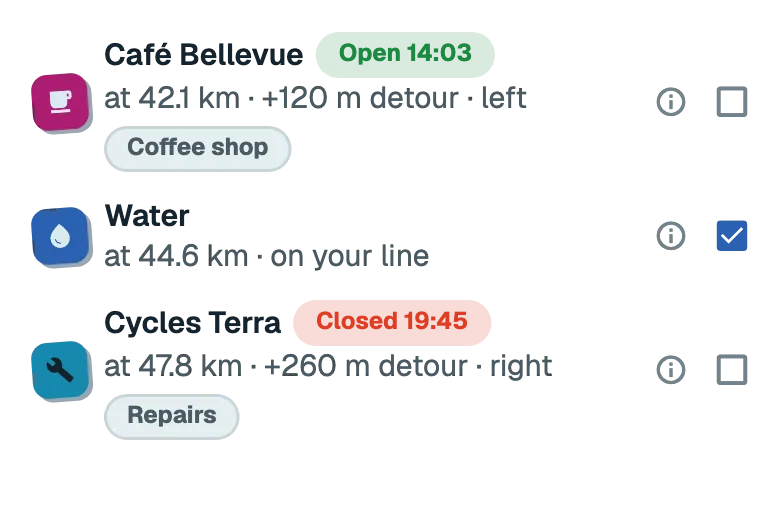
Seasonal, fee, customers only — and the good news too: repairs, a pump, free water. Water you can’t drink never makes the list.
Water, food, coffee, viewpoint and generic are one tap away, and fifty more sit behind a searchable page.
Draw a route on the map, browse what your bike computer already carries, and keep a library on your phone.

Tap waypoints on the map, pick trekking, fast bike or shortest, and see distance and climbing before you commit.
Your routes stay on your phone, searchable and sorted by recent or nearest. A ride you finished can become a route you ride again.
See the routes your bike computer is already carrying, and tap one to pull it into your library.
Download a route’s map — hillshade and contours included — plus its stops, so the whole thing keeps working with zero signal.
Add a place to the route you’re already riding, without redrawing the rest of it.

Pick a place and either re-plan from there to the finish, or take a there-and-back that rejoins where you left off.
“Marktplatz Stuttgart”, or just “bakery”, finds real places near you — or share a pin straight in from Google or Apple Maps.
Phone to device over Bluetooth, stops intact, cue noise under your control.
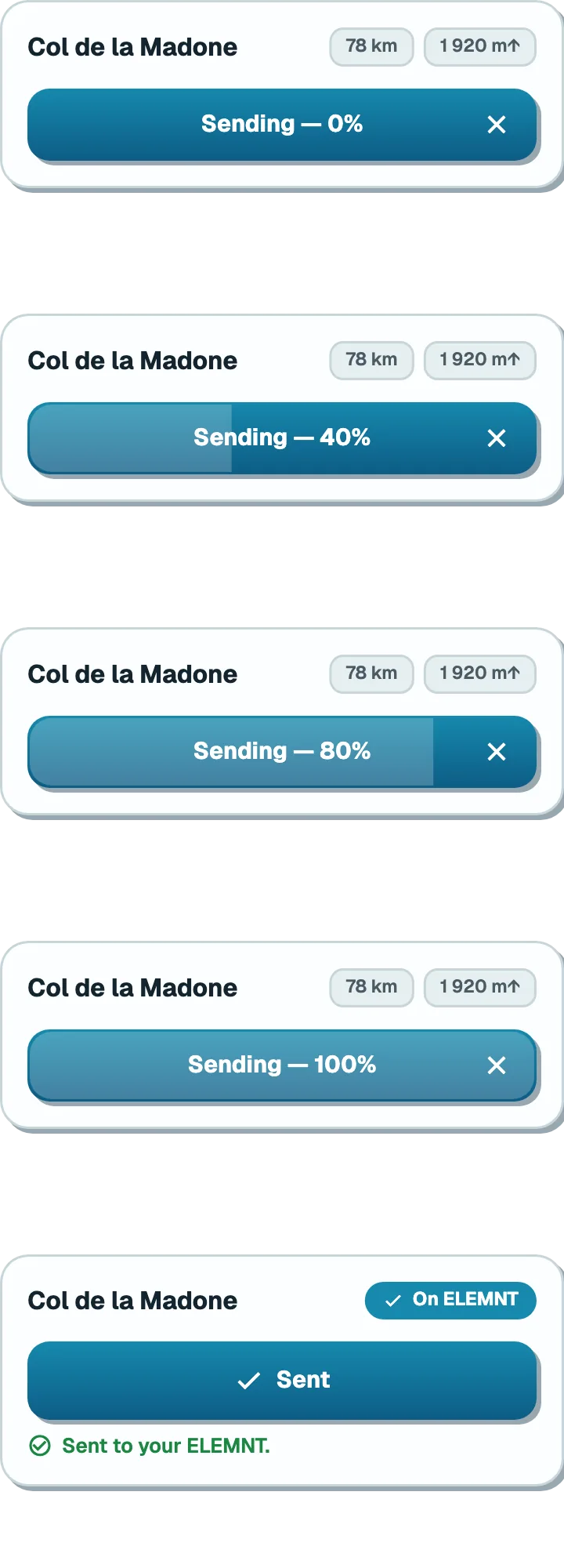
Straight from your phone to the bike computer — no cloud, no cable — and the unit starts navigating the moment it lands.
The stops you marked travel with the route and show up on the device as you ride past them.
An imported route is mostly cue noise. Keep every cue, keep only the turns that need a decision, or strip them for a clean line.
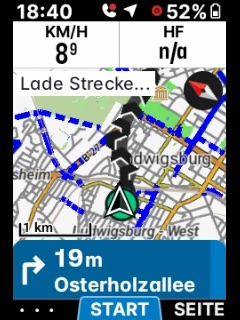
Every ride in one list, pulled off the bike computer over Bluetooth and uploaded to Strava on its own.

Every ride in one list, whether it’s already on your phone or still on the bike computer.
Pull finished rides across over Bluetooth — one, or all of them at once.
Pause at a junction, ride on, and your bike computer records an hour of nothing without a word. BikeOtter puts a message on its screen.
Opt in and your rides upload themselves, oldest first.
The forecast for where you’ll be when you get there — and a sunscreen reminder that follows the sun.
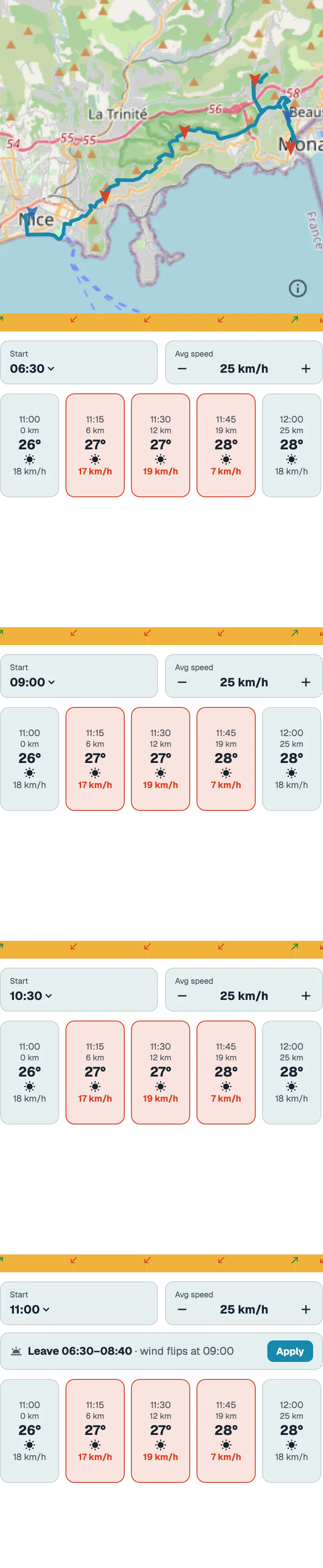
And the full report: temperature range, wind verdict, the wet stretch.
Headwind and tailwind for the direction you’ll be riding, at the hour you’ll be there — not the wind at the car park, now.
It looks across the next 12 hours and tells you the best time to set off. One tap moves your plan to it.
Headwind out, tailwind home? It offers to flip the route — one tap, no refetch. Quiet when the wind’s already at your back.
Two hours measured, four forecast, under your route. Drag the profile and the rain moves with your thumb — so you see whether it gets there before you do.

Rain, headwind, gusts and temperature swings — on the screen before you ride into them.
On the screen while there’s still a junction to take it at, pinned to where the risk starts. From the forecast, so a heads-up and not a lightning detector.
Set your skin type and the bike computer nudges you to reapply, on a clock that follows the UV and only runs while you’re out in it.
Your own alerts on the screen in front of you — and quiet when you’re descending fast.

—and the preview shows the exact words that land on the screen.
Alerts of your own on the screen in front of you, with presets for drinking, eating, heart-rate zones, weather and sunscreen. On Android, phone notifications can ride along too.
Choose what sets it off, what the device says, and how often it may repeat.
Above 40 km/h on a descent nothing interrupts you — messages wait and arrive once you level out. Rain and gust warnings still come straight through.
A live link friends can follow for the whole ride — and message you back on.

Group rides: everyone on one shared map, live.
Flip the switch and friends open a link — no account, no app — and watch your ride move on a map. It expires by itself after six hours.
Whoever you sent the link to gets a note when the ride ends — distance, time, when you got in. Optionally one before you arrive.
A wrong turn or an out-and-back can’t rewind it, and a rider who stopped shows PAUSED rather than a dot that quietly went still.
A long valley costs you the valley and nothing more, and a session that ran out mid-ride comes back on the same link.
Ride together and see everyone on one map — join by link or QR code, ten riders for twelve hours. Made for event day, with your people at home watching too.
Group-ride companions show up on the bike computer’s own map, not just the phone. Those up the road are tagged markers — JB, JB2 if shared; those beside you stay off it. ROAM and BOLT, V1 and V2.
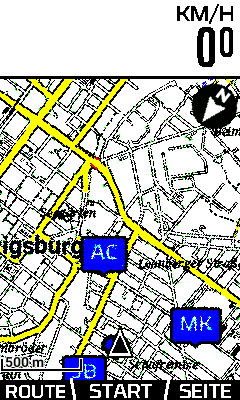
While you share a link, your phone keeps its own copy of the ride — so a unit that comes back empty isn’t the end of it. Rebuild it into your history, ready for Strava.
Anyone you allow gets a message box on your tracking page. A fresh message reaches the bike computer’s screen; the rest wait in the app.
Structured efforts a bike computer can’t run — placed only where the road holds them, cued on its screen.
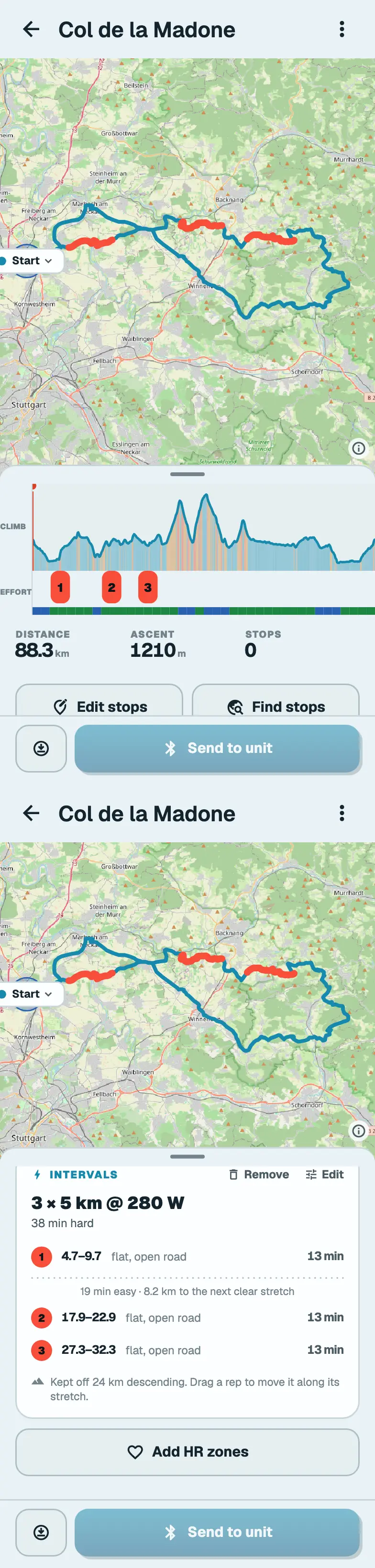
Set reps, effort and recovery; each lands only on road steady enough to ride it — no descents, no hairpins — and the plan says so, honestly, when they don’t all fit.
As you reach each effort the unit shows it on its screen — a heads-up, the start, the end — a structured workout on a device that can’t run one.
Not everything earns a chapter. These ship all the same — and the last word goes to you.
Make the unit buzz when it’s under the café table or in the wrong jersey pocket. Works on a Garmin too.
While the unit records, your phone keeps its own copy — so a flat battery or a crash doesn’t cost you the ride. Free, because losing a ride is not a thing to charge for.
GPX for the line, FIT for the workout — power, heart rate, laps.
Browse your saved routes and pull one straight in — with its turn-by-turn cues, which a route imported from Strava can’t carry.
Tap a route file in a file manager, or share it in from any app, and it opens in the editor ready to ride.
Rather than dividing what’s left by your average speed, it works out what the climbs still to come will cost you.
Paved, gravel or rough — drawn along the route and the climb, with a breakdown. Works whether you draw the route in the app or bring one in from anywhere.
Temperature range, the worst of it pinned to a time and a place, and wind named head, tail or cross for the way you’ll be going.
Share the whole plan instead of a file — the route, your start time, even the forecast. Everyone who joins gets it in their own library with one tap.
Pick which apps get through — messengers on, the parcel tracker off — and calls always come through.
Queue the route and BikeOtter sends it the moment your bike computer next connects.
Half of this book started as somebody’s request, and we are eager to hear what you are missing. Put it on the wishlist, or vote on what other riders have asked for.
Open the wishlist →Two things taking shape alongside the rest, and one thing left out on purpose.
Build intervals by time, distance or open-ended, with power, heart-rate or cadence targets, then send the workout to the bike computer.
Sending a route to an Edge 540 works today, along with pairing and making the unit beep. Ride download, workouts and on-screen alerts are on their way.
No live dashboard on the phone — the bike computer is the instrument, and a phone is the worst place to repeat it. And no segments, until they can be done properly.